
The 5-Minute Rule: Why the Business That Calls Back First Gets the Job
You didn't lose that job because your price was too high.
You lost it because you called back Tuesday, and somebody else picked up Friday afternoon.
Here's what actually happens when a homeowner in San Ramon needs a plumber, a detailer, an electrician, a landscaper — anyone. They search. They call the first result. If nobody answers, they don't leave a voicemail and wait patiently. They hit the back button and call the next one on the list. Whoever picks up — or responds first — gets the conversation. And the conversation is where the job gets won.
The window is smaller than you think
The research on this is brutal:
Roughly half of calls to small businesses go unanswered. Not on slow days — on average.
85% of people who reach voicemail never call back. They don't hate you. They just already found someone else.
Responding to a lead within 5 minutes makes you about 9x more likely to convert them than responding within an hour. Not 9 percent better. Nine times.
Read that last one again, because it's the whole game. The difference between a five-minute response and a "I'll get to it after this job" response isn't a slightly worse result. It's usually no result at all.
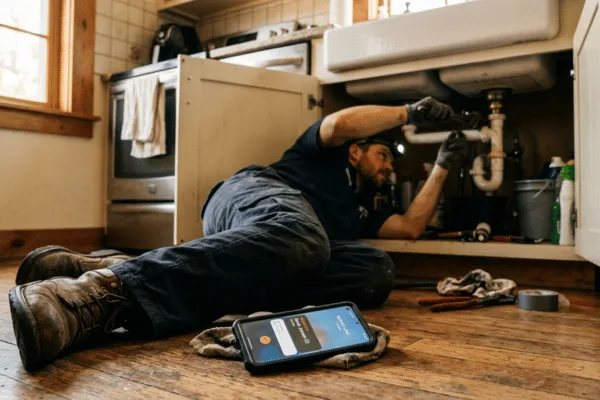
"But I was under a sink"
Of course you were. That's the trap for every service business in the Tri-Valley: the better your business is doing, the worse you are at answering the phone. You're busy doing the work that got you the reputation that made the phone ring — and the phone rings while your hands are full.
You can't answer every call. Nobody can. The businesses winning right now aren't answering more calls than you. They've just stopped letting a missed call mean a lost customer.
What the fastest businesses actually do
They automate the first five minutes. Two systems do the heavy lifting:
1. Missed-call text-back. Someone calls, you can't pick up, and within seconds they get a text: "Hi, this is Mike's Plumbing — sorry we missed you! What can we help with?" That text does something a ringing phone can't: it starts the conversation before your competitor does. The customer feels heard, and they stop dialing down the list.
2. An AI receptionist. For calls that need more than a text — questions, scheduling, after-hours — an AI receptionist answers every call, every time, books the appointment, and sends you the details. No hold music, no voicemail, no "call back during business hours." (What happens when someone calls your business at 7pm on a Saturday? That's a whole topic on its own — and for most local businesses the honest answer is "nothing good.")
Neither of these requires hiring anyone. They run in the background, 24/7, and they're the reason a two-person operation can out-respond a company five times its size.
Try this today
Call your own business from a number it won't recognize, at a time you know you're busy. See what happens.
If it rings out to voicemail — that's exactly what your next customer heard. And now you know why the quote requests feel slower than the traffic your website gets.
The fix isn't working harder or gluing the phone to your hand. It's making sure the first five minutes happen automatically, whether you're available or not.
Want to know how many calls you're actually missing? Book a free 15-minute call and we'll look at your response setup together — no pitch, just the numbers.
Net Marketing Advantage helps local businesses answer faster, follow up automatically, and stop losing jobs they should have won. Based in San Ramon, CA — serving the Tri-Valley and beyond. 925.905.8740


